SIFE unit of K J Somaiya Institute of Management were the regional winners of SIFE 2008 conducted on June 19 th, 2008. At the National Competition 2008, they were appreciated a lot by the jury though they were not the winner. The media report is as follows:
SIFE to bring out leaders and entrepreneurs
Alpha Arts and Science College emerged winner at SIFE India National Competition while JIS College, Kolkata were the winner-up
Alpha Arts and Science College emerged winner at SIFE India National Competition
Making a difference in the society at a tender age of 20 is definitely not an easy task. Tsunami waves completely ravaged Pannayarkuppam village of Tamilnadu and the government funds ceased and the fisherman community was badly affected. Alpha Arts and Science College representing SIFE India undertook the seaweed cultivation project and successfully made it an alternative occupation for the fisherman community. The fishermen were in a need of an alternative occupation. As their expertise lay in sea related activities, these children of the sea were unable to adapt to any other occupation. The SIFE team ensured the profitability of the project and analyzed the global market statistics to establish it among the fisherman community. They identified buyers and suppliers of seaweed across India and made Pepsico a major buyer of this community. Alpha Arts and Science College emerged as the winner of SIFE National Competition. More than 100 students from 35 colleges all across India participated in the SIFE National Competition. Four Regional competitions were held this year in Chennai on June 4, in Delhi on June 12 and in Mumbai on June 19. This year the Alpha Arts and Science College (The winner team will represent India at the World Cup at Singapore on Oct 1-3 2008.)
The runner-up team was JIS College from Kolkata. Jesus and Mary college from Delhi received Rookie award of the year. K.J. Somaiya from Mumbai was also appreciated a lot by the jury for their service to the society.
Some of the projects represented at SIFE National Competition are: JIS College, Kolkata: Established a medical information system has been set up in the Sunderbans, West Bengal making information on hospitals, doctors available, just a call away. Jesus and Mary College, Delhi: Migrant women from the Bhatti mines of Mehrauli, Delhi were rendered jobless after the earthquake in 1990. Jesus and Mary College students established a business model under which this women community were taught to make handmade products like bags and baskets. They identified the end buyers and suppliers, which could give them the raw material at subsidized rates. This project completely uplifted the status of this women community and the project is running successfully in the Mehrauli area of Delhi.
K.J. Somaiya from Mumbai: (Though not winner but was appreciate a lot) K.J.Somaiya College students realized the problem of a large community of immigrant workers in Dhokali Gaon, Thane, who could hardly earn anything because of the lack of any professional skill. Project Initiative: Imparting professional skills like embroidery and tailoring to women in order to help them attain economic stability. Providing tailoring kits and sewing machines (including industrial machines). Building a suitable business model for income generation. Improving the exposure and awareness of women, thereby increasing their self-confidence. Assisting the children of the family with their academics. Inviting industry experts/persons to oversee and evaluate the skills of the women of this community.
All these projects were judged by dignitaries like: * Keshav R. Murugesh – Chairman, SIFE India, President & Chief Operating Officer, Syntel Inc. * Rupendra Singh – Vice Chairman SIFE India, Non Executive Chairman KPMG India * Malini Thadani – Director SIFE India, Head of Public Affairs and Corporate Responsibility, HSBC India * Sudip Bandyopadhyay – Director SIFE India, Director & CEO, Reliance Capital Ltd.
Chairman of SIFE India, Keshav Murugesh says, "SIFE offers these students the opportunity to develop leadership, teamwork and communication skills through learning, practicing and teaching the principles of free enterprise, thereby improving the standard of living for millions in the process. We endeavor to teach important concepts to college students through educational outreach projects, including market economics, entrepreneurship, personal and financial success, and business ethics to better themselves, their communities and their countries."
The link for media report is : http://www.ciol.com/EC/News-Reports/SIFE-to-bring-out-leaders-and-entrepreneurs/23608107344/1/
Monday, June 23, 2008

Wednesday, June 04, 2008
A Visit to Nareshwadi (Project Warli)
Two Somaiya Social Cell members – Vikram and Shruti- made a visit to Nareshwadi – the community under Project Warli. The visit was part of the exchange visit for the students from NOVA university (based in US), who are currently pursuing MBA. Rather than me telling the narration of the visit, it is better to hear form the horse’s mouth. Vikram writes about his experience and the experience of the foreign students who visited the Nareshwadi school.
“There is only one word...in fact two....for the trip to Nareshwadi..."Simply" amazing....an the emphasis on the word simple is because that is what Nareshwadi is all about and the experience was yet out of the world. Shruti and I accompanied the foreign students. The travel from Mumbai to Nareshwadi was endless. The bus took us four long hours as we got stuck up in a traffic jam on the highway. When we reached Nareshwadi, we were quite exhausted but the welcome by the students of Nareshwadi school was too overwhelming for us to remain tired. We had breakfast and we immediately set off for the market at Nareshwadi.The market was about 6 kilometers from the school. En route we caught a glimpse of tribal life - Huts, dry paddy fields, cows and tribal villagers. But the fact was that – that is the real India.
The market was more like a ‘Mela’. Everything was laid out on the ground on newspapers the product range varied from pirated CDs to locally made Jalebis, from Bindis to plastic toys. The foreign students were overwhelmed. They had seen the malls in their home land but never a rural market. But that never prevented them from shopping.We returned, had lunch and were off for a site visit. Inka Pibilova, a Czech who has been working extensively with the NGO along with Patricia madam, showed us around with the enthusiasm of a child. We went to the classes where the students were studying. The classrooms were open without any windows or doors - a system which Inka said was about fresh air, sunlight and improved learning. The students, as young as 8 years old, were overjoyed and were eagerly showcasing their talent by reciting poems and singing songs for us. We had tears in our eyes literally because of the startling fact that one of the largest growing economies of the world had such a poor side to it too. We then went to their hostels where the children stayed. Each hall accommodates around 30 students and all sleep on the floor on a clad mattress with just a trunk to hold their clothes and yet they strive for a better life and better education. I was reminded of my hostel and the cribbing I had about it and my cribbing was reduced to nothing. Nareshwadi school has 500 children, mostly from the tribes and a few from HIV affected parents - the harsh truth.
We saw the vocational training institute of Nareshwadi, which trains students in carpentry, building and painting. These were taught so that the same skills can be used inside the nareshwadi school and it was being implemented there. The vocational students have built their own water tanks and small houses inside the school.We had a cup of tea after which we visited the vegetable and fruit fields inside the premises. The most unbelievable part of the whole visit!!! Spread over a huge land, the fields hold all kinds of vegetables and fruits. You name it and they are there. These vegetables are grown and the same are used to cook food for the students. There is also a dairy which provides milk and also safeguards certain rare species of cows and buffaloes. Fermi compost is used for better growth of vegetables. Drip Irrigation is used for water supply across all fields. The foreigners were really startled and so were we. We then saw the biggest banyan tree ever inside the campus. It was a truly amazing experience.We then came back for another cup of tea and interacted with the school children. We had a chat with them for a long time and had real childlike fun. The joy in their eyes, in seeing and talking with us, moved us all.I can go on writing about Nareshwadi because it was an amazing experience for both me and Shruti. But the thought that really struck our minds was that the biggest joy in life is to make others feel they are cared for and I am really glad that I had an opportunity to experience that.
I personally suggest a visit to Nareshwadi with all the social cell members as a group. There are certain things in life which when we experience makes us think that Life is truly a gift and that experiences in life must be shared with.
- Vikram
“There is only one word...in fact two....for the trip to Nareshwadi..."Simply" amazing....an the emphasis on the word simple is because that is what Nareshwadi is all about and the experience was yet out of the world. Shruti and I accompanied the foreign students. The travel from Mumbai to Nareshwadi was endless. The bus took us four long hours as we got stuck up in a traffic jam on the highway. When we reached Nareshwadi, we were quite exhausted but the welcome by the students of Nareshwadi school was too overwhelming for us to remain tired. We had breakfast and we immediately set off for the market at Nareshwadi.The market was about 6 kilometers from the school. En route we caught a glimpse of tribal life - Huts, dry paddy fields, cows and tribal villagers. But the fact was that – that is the real India.
The market was more like a ‘Mela’. Everything was laid out on the ground on newspapers the product range varied from pirated CDs to locally made Jalebis, from Bindis to plastic toys. The foreign students were overwhelmed. They had seen the malls in their home land but never a rural market. But that never prevented them from shopping.We returned, had lunch and were off for a site visit. Inka Pibilova, a Czech who has been working extensively with the NGO along with Patricia madam, showed us around with the enthusiasm of a child. We went to the classes where the students were studying. The classrooms were open without any windows or doors - a system which Inka said was about fresh air, sunlight and improved learning. The students, as young as 8 years old, were overjoyed and were eagerly showcasing their talent by reciting poems and singing songs for us. We had tears in our eyes literally because of the startling fact that one of the largest growing economies of the world had such a poor side to it too. We then went to their hostels where the children stayed. Each hall accommodates around 30 students and all sleep on the floor on a clad mattress with just a trunk to hold their clothes and yet they strive for a better life and better education. I was reminded of my hostel and the cribbing I had about it and my cribbing was reduced to nothing. Nareshwadi school has 500 children, mostly from the tribes and a few from HIV affected parents - the harsh truth.
We saw the vocational training institute of Nareshwadi, which trains students in carpentry, building and painting. These were taught so that the same skills can be used inside the nareshwadi school and it was being implemented there. The vocational students have built their own water tanks and small houses inside the school.We had a cup of tea after which we visited the vegetable and fruit fields inside the premises. The most unbelievable part of the whole visit!!! Spread over a huge land, the fields hold all kinds of vegetables and fruits. You name it and they are there. These vegetables are grown and the same are used to cook food for the students. There is also a dairy which provides milk and also safeguards certain rare species of cows and buffaloes. Fermi compost is used for better growth of vegetables. Drip Irrigation is used for water supply across all fields. The foreigners were really startled and so were we. We then saw the biggest banyan tree ever inside the campus. It was a truly amazing experience.We then came back for another cup of tea and interacted with the school children. We had a chat with them for a long time and had real childlike fun. The joy in their eyes, in seeing and talking with us, moved us all.I can go on writing about Nareshwadi because it was an amazing experience for both me and Shruti. But the thought that really struck our minds was that the biggest joy in life is to make others feel they are cared for and I am really glad that I had an opportunity to experience that.
I personally suggest a visit to Nareshwadi with all the social cell members as a group. There are certain things in life which when we experience makes us think that Life is truly a gift and that experiences in life must be shared with.
- Vikram
Seminar on "Managing NGOs Effectively"
The Seminar on Managing NGOs Effectively was held on 19th February 2008 at the auditorium of KJ Somaiya Institute of Management Studies and Research, Mumbai. The event took off with the traditional Prayer of Somaiya. Mr. Ernest Fernandes, Chairman Management Week Committee, from BMA welcomed the Guests & Speakers & mentioned the intent of Celebrations of Management Week in his introductory speech. Mr. Inderpal Singh, Ex-President, BMA & Ex-Head of Production at Godrej Industries was the Chief Guest of the seminar. Mr. Singh emphasised on the importance & relevance of Non Government Organisations in today’s changing corporate landscape. He also expressed his gratitude that the youngsters are also coming up for social cause & helping in building a just & happy society. Mr. R.Subramanian, a renowned Management Consultant & a Guest faculty at SIES, Nerul was the next Keynote Speaker. He laid emphasis on the spiritual relevance of doing the Social work & also thrown some light on the various social developmental activities taken up by various religious institutions & how they are managing their resources in the greater cause of the nation.

Mr. Ramesh Khanna, who has served on the board of various PSUs in the past & is currently practicing financial consultancy spoke on the importance of maintaining transparent accounts. He emphasised on the criticality of effective reporting of finances to all its stakeholders for a public entity, especially NGOs. More transparent an organisation is, more is its credibility & in a way that also increases the efficiency of the NGO. It was Prof. Isaac Jacob, Marketing faculty at KJ SIMSR, Mumbai & Ex-Marketing Head of various MNCs, who spoke about the Marketing dimension of NGOs. He focussed his speech around an AIDS campaign by some NGOs with a Protagonist named BALBIR PASHA & showed some print & TV advertisements. Mr. Savio Vegas presented some crisp facts about the NGO Sector in India & emphasised the need of institutionalizing the NGO Sector. He also apprised the audience about the presence of a framework which certifies the NGOs & also gives them rating before making the forum open to audience for Questions & Answers. Representatives from various NGOs had some doubts in their minds relating to the legal framework which were answered by Mr. Vegas.
Mr. Gladwyn Pinto, Executive president, BMA who also was amongst the distinguished guests expressed his gratitude. Prof (Dr.) Suresh Ghai, Director of KJ SIMSR & Secretary of BMA, concluded the seminar & gave vote of thanks to all the distinguished guests & representatives of NGOs & expressed his gratitude as a host of the event. The Seminar ended with the National Anthem.
Mr. Ramesh Khanna, who has served on the board of various PSUs in the past & is currently practicing financial consultancy spoke on the importance of maintaining transparent accounts. He emphasised on the criticality of effective reporting of finances to all its stakeholders for a public entity, especially NGOs. More transparent an organisation is, more is its credibility & in a way that also increases the efficiency of the NGO. It was Prof. Isaac Jacob, Marketing faculty at KJ SIMSR, Mumbai & Ex-Marketing Head of various MNCs, who spoke about the Marketing dimension of NGOs. He focussed his speech around an AIDS campaign by some NGOs with a Protagonist named BALBIR PASHA & showed some print & TV advertisements. Mr. Savio Vegas presented some crisp facts about the NGO Sector in India & emphasised the need of institutionalizing the NGO Sector. He also apprised the audience about the presence of a framework which certifies the NGOs & also gives them rating before making the forum open to audience for Questions & Answers. Representatives from various NGOs had some doubts in their minds relating to the legal framework which were answered by Mr. Vegas.
Mr. Gladwyn Pinto, Executive president, BMA who also was amongst the distinguished guests expressed his gratitude. Prof (Dr.) Suresh Ghai, Director of KJ SIMSR & Secretary of BMA, concluded the seminar & gave vote of thanks to all the distinguished guests & representatives of NGOs & expressed his gratitude as a host of the event. The Seminar ended with the National Anthem.

Saturday, April 05, 2008
Somaiya Social Cell project gets highlighted in DNA News
Haath mein Sehat, one of the projects in Somaiya Social Cell, gets media coverage in CoastWatch column of DNA newspaper dated March 2008. The news article is given below:

Volunteers from
They will be in the city for the Health in Hand project
About forty percent of the nation’s wealth is generated from Bandra, which is a city of 14 million, where the world’s rich and famous people rub shoulders with some of the poorest people on earth. With real estate at a premium, nearly fifty percent of the city’s residents live in quasi legal slums like Behrampada, a crowded community that spills from across the street and into the train station itself. It is here that Yu and a small group of volunteers from University of California (UC), Berkeley called Haath Mein Sehat, or Health in Hand, have been spending school breaks since 2004 working to improve access to safe drinking water. They are also putting efforts to ending an epidemic of diarrhea for the estimated 1,75,000 residents of this slum.“There is a bunch of students from the university who come down to

Monday, March 24, 2008
Mehendi kiosk for Women's Day
Mehendi kiosk for International Women's Day
International Women's Day is marked on March 8 every year. It is a major day of global celebration for the economic, political and social achievements of women.
Somaiya Social Cell has always tried to help women become financially stable such that they gain confidence and make a mark. Many of our projects are focussed on womens' development. Mehendi project is one such project.

This year, Mehendi team of the Social cell had the oppurtunity to take part in the Women's Day Celebrations of Idea Cellular, Mumbai.
On March 7, the Mehendi project set up a kiosk in Idea Cellular Office, Kalina, Mumbai. Thanks to our alumni Mr.Mukesh Tibrewala who is an employee of Idea, because of whom we got this opportunity.
The kiosk was set up from morning 10:00 am to 5:00 pm. Volunteers Akhila Sekhar & Seema Goswami took incharge of the kiosk. The kiosk was a major success. There were six women who worked tirelessly to apply mehendi for 30 hands. The total earnings was Rs. 2165. Adding to that, the women developed good contacts, as many of the employees collected their phone numbers.

Thus, we celebrated the spirit of Women's day by leading them take another step in the path of financial independence.
Sunday, February 17, 2008
Managing NGOs Effectively
Bombay Management Association and K J Somaiya Institute of Management Studies & Research present a seminar on "MANAGING NGOs EFFECTIVELY " as part of Management Week 2008 celebrations.
Key Note Speakers :
1. Mr. Ujjwal Bannerjee -HR Aspects of NGOs
Lead India Finalist, Manager- HR, Akanksha Foundation.
2. Prof. Isaac Jacob –Marketing & Branding of NGOs
Faculty, K J Somaiya Institute of Management Studies & Research, Mumbai
3. Mr. Bhagwat Rewati -Accreditation & Credibility of NGOs
Director, Credibility Alliance
4. Mr. Savio Vegas - Legal Dimensions
Legal Consultant
Mr. Inderpal Singh, Ex - President, Bombay Management Association, would preside over the function.
Venue : The Auditorium
K. J. Somaiya Institute of Management Studies & Research
Vidyanagar, Vidyavihar
Mumbai - 400077
Date : 19th February, 2008
Time : 4:00 PM – 6:30 PM
Key Note Speakers :
1. Mr. Ujjwal Bannerjee -HR Aspects of NGOs
Lead India Finalist, Manager- HR, Akanksha Foundation.
2. Prof. Isaac Jacob –Marketing & Branding of NGOs
Faculty, K J Somaiya Institute of Management Studies & Research, Mumbai
3. Mr. Bhagwat Rewati -Accreditation & Credibility of NGOs
Director, Credibility Alliance
4. Mr. Savio Vegas - Legal Dimensions
Legal Consultant
Mr. Inderpal Singh, Ex - President, Bombay Management Association, would preside over the function.
Venue : The Auditorium
K. J. Somaiya Institute of Management Studies & Research
Vidyanagar, Vidyavihar
Mumbai - 400077
Date : 19th February, 2008
Time : 4:00 PM – 6:30 PM
Thursday, February 14, 2008
Somaiya Social Cell wins financial grant from HSBC
True to its vision of empowering people, the Somaiya Social Cell succeeded in getting financial aid for providing financial literacy to the handicapped people working at NASEOH data entry centre. SIFE (Students in Free Enterprise) in conjunction with the HSBC Global Education Trust and HSBC conducted the HSBC Financial Literacy Programme. Under this programme, HSBC funds those projects which aims to provide financial literacy to the needy people. This year, it received around 400 applications from various countries including
Tanvi Shikha and Juhee Prashant submitted the proposal on behalf of K J Somaiya Institute of Management Studies and Research. In the proposal they listed a detailed plan as to how they want to provide financial literacy to the handicapped employees working in the data centre established by NASEOH. NASEOH is an NGO established by a group of industrialists, doctors, philanthropists and social workers under the leadership of Late Shri Vijay Merchant, in
Deepa Garge and Nirav Shah from PGDM volunteered to help Tanvi and Juhee in the financial literacy programme. As the first step, they conducted a class on personal savings for the employees at the data centre. They have future plans to organize classes by SIMSR faculty in Finance Department. This endeavor has made the Somaiya Social Cell to further deepen the ties with SIFE and HSBC.
Monday, February 11, 2008
Skit on Cancer Survivor's Day ...
Somaiya Social Cell has always been on the forefront to serve people in all fields. Education, Employment .. you name it and Social Cell has made a significant contribution. The latest initiative by Social Cell was in the field of Art and Dramatics ... unbelievable ?? But friends, its true :)
Vasantha Memorial Trust which works for the cause of cancer conducted a special cultural program for the occasion Cancer Survivors' Day on 9th Feb in Manek Mahasabha, Bandra.
They contacted various colleges to perform for the patients and survivors. Our college was also invited. We, in the Social cell did not wish to miss this oppurtunity.
A funny skit was then made ready.
The Skit team

Following were the 'actors' in the play..
Rahul Manchanda
Meena Sangishetty
Prabal Mittal
Vaishali Dhar
Siddarth Vij
Richa Khetawat
Beno Ewald
Akhila Sekhar
and the real hero of the play Rajat Malhotra. Rajat carried the whole play so smoothly and in an absoulutely professional way. He was like the backbone of the play and the secret of our success.
Om Kumar Jha helped us with the screen play and dialogues and also helped us by being the critic ... :)
The play was received very well with requests for 'Encore' !!
Very special thanks to be mentioned to Satyam Tewari who supported us by being there throughout with us and who captured the memorable moments in the video.
Also thanks to Rishikesh kumar, Azam Ali Khan & Praveen who attended the program and encouraged us.
And finally and most importantly thanks to DG Sir and Radha Ma'am who gave us this oppurtunity to do something for the cancer patients and survivors.
We look forward to working with the Vasantha Trust and fighting against cancer.
Mrs. Jaya, co-ordinator, Vasantha Trust and the Performing artists.. :)

Thursday, January 31, 2008
Republic Day - 08
Tu dhoop hai, chham se bhikhar,
Tu hai nadi o bekhabar ,
Udd chal kahin dil khush jahaan,
Teri to manzil hai wahi ......
This beautiful song appeared more meaningful on our 59th Republic Day ... when kids with overwhelming enthusiasm and vivacity sat down to unleash their imagination and creativity ...

Republic day this year was celebrated with a fervour of patriotism. Kids were taken to witness the flag hoisting at the KJ Somaiya Arts College by the NCC cadets. They were in high spirits after witnessing the March past by the NCC Cadets and marched back after the flag hoisting.

They then munched on some biscuits, and sang aloud a few patriotic songs like Mere Desh ki Dharti to their(and our) heart's content :)

We had a short break .. and at 10:30 am , we began the most awaited event of the day - the PEHEL ART COMPETITION !! .. Pehel art competition was open to all .. including the students of SIMSR...
There were 20 kids who were dressed in their best with their eyes beaming with excitement ... and there were almost equal number of volunteers from SIMSR who did not want to miss the fun ! ...

The competition was organised by Jyoti Gouda, Seema Goswami and Akhila Sekhar.
The Volunteers were Om Kumar Jha, Pranshu Gupta, Soumya Iruvanti, Tanvi Shikha, Avipsha Banerjee, Sangeeta Sengupta, Ashish Maheswari, Rishikesh Kumar, Subhasish Sarkar, Hirak Sarkar, Juhee Prashanth, Richa Khetawat, Ajay Choudhary and Beno Ewald.
To encourage the kids, many of the volunteers sat beside them and tried their hands at art too !!

The kids were given a choice - if they wanted to draw and colour or .. just colour the drawings.. a couple of kids chose to draw and the majority chose to colour .. and the fun began ! ...
Have you ever seen a Blue coloured sun ??? or a pink coloured rocket ?? or multi-coloured stars ??? We have :) !! ... It was the kids' innocence and creativity that reflected upon the paintings... To see them fill colours ... was a great sight indeed... !!


The kids and the members of the team were all given chocolates as a token of appreciation :P .. !! The paintings were then judged by four judges - Subhasish, Hirak, Ashish and Beno and the prizes were declared. The kids received the prizes with wide smiles amidst loud cheers and clapping.

At the end, all of us sang the National Anthem and called an end to the amazing morning !
Wednesday, January 30, 2008
Eye check up and General health checkup camp for PEHEL students
As part of PROJECT PEHEL, Somaiya Social Cell members were involved in teaching the children of the construction workers of Somaiya Buildings at the new Somaiya Hostel. After seeing the children and the houses in which they stay, the members felt that there was a need to conduct medical check up and provide medical advices for not only the children, but also the family. Hence a General health and eye checkup for the children of construction workers (PEHEL students) along with their parents and grandparents was conducted on Dec 28, 2007 by the Somaiya Social Cell.
Cmdr. Kailash Girwalker provided great support for this whole event. The hospital staff was impressed by the way the event was organized. They asked the help of the Somaiya Social Cell in organizing such events like vaccination etc in other communities in future. The photos have been given below : -

Doctor conducting full body Checkup of a student

Doctor giving medical advice to parents

Eye checkup for parents of the students

Eye checkup conducted for students and grandparents

Doctors conducting medical checkup for parents

Parents interacting with the doctors

Social Cell members distributing fruits and snacks
Friday, January 04, 2008
Blood Donation Camp organised @ SIMSR
The Somaiya Social Cell conducted a blood donation camp in the Somaiya Institute of Management campus, for Somaiya Hospital Somaiya Hospital 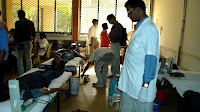


The Event
The blood donation drive started at 9 am in the morning and the room saw volunteers flocking to donate blood. The doctor and the hospital staff collected the blood and made the people comfortable while the process was on. The participation and the enthusiasm of the students who came forward to give blood was amazing and worth applauding. The camp had to be closed earlier at around 2 pm since the target was achieved beforehand. Students came even after 2 pm but were sadly sent back. The doctor and the staff were all praises for the participants and the organizers. Later, donor cards and certificates of appreciation were distributed to all the donors.

Students donating blood

Social Cell members making the donors comfortable

Social Cell members helping the hospital staff
Saturday, December 22, 2007
Mehendi @ Utkarsh

There is something mesmerizing about Mehndi and it’s no wonder that the ancient form of hand and feet painting has captivated the ladies (and now gents also) for years. It’s in the intricate designs that take hours to create, the deep crimson color which shines clearly on the skin, the earthy aroma that fills the air … that creates the magic.

It is this magic that we in our Social Cell wish to tap and use for a social cause. Mehndi project is a very successful project among our projects which has never failed to bring smile to the people whom we wish to help.

As an initiative of this project, a kiosk was set up in Utkarsh, fete of SK Arts & Science college in Somaiya Campus on Dec 22nd 2007. The kiosk was set up at around 3:30pm and went on till 8pm. Many eager students, staff and their kids applied Mehendi.

The conveynor of Utkarsh, Ms.Charlette Madam was highly co-operative and very helpful. She readily gave us the permission to conduct the kiosk and apart from that, she instructed the volunteers to arrange for a table etc and also encouraged us to make announcements on the stage to pull more crowd.

The mehendi ladies made good earnings and were very happy at the end of the day. They wished to be invited for more such occassions.
Let us look out for more such occassions: Let us Challenge destinies, touch hearts and bring more smiles :)
Wednesday, December 19, 2007
Kiosk at CitiGroup Services

Conducting Events/kiosks in Corporate offices have been a very important reason behind the success of Somaiya Social Cell. One such kiosk was conducted in CitiGroup Services, Malad, Mumbai on 25/10/07 and 26/10/07.

It was a two day event. The event was highly supported by the HR of the company who was our primary contact. The stall was publised under the name ‘Diwali Bazar’ and rightly so as the kiosk was set up shortly before Diwali.

Four volunteers Satyam, Meena, Vinnu Priya and Akhila were in charge of the stalls. SAHAS Cell pouches, Andhra Toys, Paper bags, Candles and Folders from NAB were sold in the kiosks apart from Mehendi.
We had good sales and the employees received the products very well.
 We hope to keep up this contact and build many more such Corporate Contacts and add more to our Success Stories.
Wednesday, December 05, 2007
Nostalgia 2007

NOSTALGIA – The event which brings together the alumni and the present batches and help foster a long lasting relationship between the two. Nostalgia 2007 was no different and it provided the Somaiya Social Cell a platform to keep the alumni informed of the activities and projects that the cell had undertaken the past year.
The Preparation

The preparation took off the previous night itself with all banners, charts, posters of each and every project and activity being worked out by the members. The basic aim was to provide an insight into each and every initiative that the students had taken up and the progress made in recent years. A mehendi stall was also planned, the intention being to highlight the SAHAS initiative to the public. The transition of the student body from a Somaiya SIFE chapter to an entirely social venture was presented through the new logo and banners.

The Exhibition
Founder, Dr S.K Somaiya was one among those who visited the stall and had jotted down in the log book, “Congratulations for imbibing the spirit of the founder and SIMSR. Keep it up”.

Most of the alumni who came over were very much eager to contribute to various projects and indeed most of them spoke about the cell during their interaction with the college students in the Audi. Many of them also evinced interest in joining the Business Advisory Board and also interacting with the members in future.
Feedback

Some of the comments and messages received on Nostalgia :-
“Excellent work. It has moved me! May you move mountains.” – Sheetal (1999 batch)

This event provided a platform for the students to interact with the Alumni and also highlight the work being done by the present batch. The commitment provided by the alumni has definitely paved the way for a long term relationship, the evolution of the BAB – a platform for student-alumni-faculty a step in this regard.
Wednesday, November 28, 2007
SOMAIYA SOCIAL CELL MAKES ITS PRESENCE FELT IN PUNE

The Event

The team recieved good response from the employees

Few of the products on display

Apart from the sales, we got very good feedback and ways to improve the social cell and its products. We had people asking for more of products to be couriered to them. The biggest benefit we got was in the form of NGO contacts, who became aware of the social cell and promised to call us for any assistance or tie-ups in Pune. The volunteers got a feel of the CSR activity in companies and how to market their products. More than this, the volunteers got to know about the various NGOs and their products and how they can implement changes to their existing product portfolio to build a better product.
Monday, October 22, 2007
Somaiya Social Cell organizes Great Future Cup - Underarm cricket for Discovery Channel

The Discovery/Fox channel crew had set up camp in Mumbai and were on the lookout for a partner to help document Gully cricket and Underarm cricket in India. This program called 'An Aussie Goes Bolly' (AAGB II) is a sequence to a very famous soap on cricket, AAGB. The protagonist, Mr.Gus Worland is a cricket fanatic from Australia who has become a celebrity of sorts after the runaway success of 'An Aussie Goes Balmy' (AAGB) series back home. AAGB I covered the cricket fever in England. The Fox team finally contacted the Somaiya Social Cell to help do a documentary on Underarm cricket and organize a cricket match for them in the Somaiya grounds.
Our Role
The Somaiya social cell members arranged the venue, facilitated the video shoot in the neighboring underserved community and organized the cricket match on 16th October 2007. The team involved the cell members, people from the community and the fox team. The teams were formed to reflect the best teams in the World cricket, namely Australia and India. All in all, we formed the interface between the Fox team and the community. The idea was to bring out the passion for the game that thrives even at the lowest levels. The prizes were sponsored by the TV crew.
The Match
The match was played for 10 Overs. Mr.Gus Worland was the captain of the 'Australian' team and Mr.Kaushik (from Discovery) was the captain of 'Indian' team. The Social Cell members who participated in the match were Aravind VS, Aarti Bhandari, Akhila Sekhar and Satyam. Anand Ramachandran from the Social cell was the umpire. The toss was won by the Australian team and they chose to bat. The opening batsmen Deepak and Gus sent the Indian fielders running on their toes and the bowlers were finding it hard to get the batsmen out. Eventually Gus got out. Deepak showed a good performance at the crease and at the end of 10 overs, Australia managed 93 runs. India started losing early wickets with the captain Kaushik getting out. Slowly wickets started falling and India was all out for 60 runs. It seems even in under arm cricket India has to go a long way to reach the standards of Australia.

The match evoked a lot of interest from the community
The awarding ceremony of the Somaiya Social Cell 'Future Cup' was presided by Social Cell mentor, Mrs. Radha Iyer, who congratulated both the teams for their enthusiastic participation. Deepak from the Australian team was declared 'Man of the Match'. Akhila Sekhar from the Indian team was declared 'Woman of the Match'. Both of them were awarded with a VIP- Lounge ticket to view the Future Cup cricket between Australia and India to be held on 17th October in Mumbai. The match ended with a big round of applause from the audience for the Social cell team and the Fox team.

The fox team, just before the shoot...
The Publicity
The match was a huge crowd puller, with lot of spectators ranging from school children to the local workers. All the people who passed by had a look and enquired about the whereabouts and did not budge until they had seen at least some part of the match. The people from the community, the volunteers from the Social Cell as well as the Discovery/Fox team actively took part in the initiative and were able to enjoy each and every moment of the game. After the match, the Media team interviewed Mrs.Radha Iyer and Anand Ramachandran about the activities of the Social Cell and about the Indian element which the Australians should carry home after their assignment in India.

Somaiya Social Cell members with Gus Worland and team
The posters portraying the Somaiya social cell were put up in places which ensured high visibility. The banners as well as the labels(which were stuck to the t-shirts of the players) were explicit and they added to the publicity. We have also established good contacts with the Media team which can be leveraged to cover any social events in future. Almost all the people who passed along the place or who were living there came to know of our effort in organizing the match and more than that, the name of Somaiya Social Cell had become the common name of the neighboring areas of the Somaiya College.
More on Gus Worland and the Barmy Army:
http://www.granadaproductions.com.au/auba.html
http://www.telegraph.co.uk/sport/main.jhtml?xml=/sport/2006/11/23/scbrig23.xml
Monday, October 08, 2007
Project Warli
WARLI
The Art
Warli paintings, have originated out of the life and rituals of the Warli tribe. This simple yet vivid painting style is believed to have originated sometime around the tenth century A.D. However, considering its simplicity in form and figure, it can be assumed to be dating back to the Neolithic period between 2,500 BC and 3,000 BC. Warli paintings express everyday life using extremely basic object forms and just one color - white - on a sober mud base. The appeal of these unicolor compositions with elementary object forms lies in their lack of pretentiousness in conveying the profound. Each painting is usually an entire scene that contains various elements of nature including people, animals, trees, hills etc. Decorative patterns inspired by nature are also used. The themes are often repetitive and symbolic in nature. Warli Unlike any other school of painting does not use mythical or religious iconography. Rather it rejoices in the celebration of simple folk life and its mundane customs.
The tribe
Dahanu, (Maharashtra) happens to be one of the very few remaining habitats of the Warli tribe. The Warlis who number about 300,000 in populations in Dahanu taluka own only 45,000 acres of land of the total acreage. They are mostly marginal and landless laborers and work in the commercial fruit orchards of the prosperous farmers in the region, or in brick kilns in nearby towns. The Warlis remain quite unassimilated from the rest of India; they maintain their own dress style, customs, religion and ceremonies. They have gained recognition only for their unique work of art, known the world over as Warli Painting.
The artist
Jayesh, a 16 year old boy, is very shy and speaks through his paintings. He keeps on drawing paintings for hours and hours. He got introduced to Warli art through his family. He has developed his skills because of encouragement from school and professional training provided from them. He is an aspiring candidate for Elementary examination of Drawing and wants to be a renowned Warli artist.

Jayesh displaying the painting, alongside SIMSR students
The Nareshwadi Residential School
The GVPM School is located on a 270-acre campus. It provides free schooling and residential facilities for the tribal children who come from villages as far as 25 kms. It runs from class 1 through 10 (secondary school) and has 13 trained teachers. The GVPM has introduced several initiatives towards child-centered learning and ensures an integrated approach incorporating classroom curriculum with exposure to agriculture, horticulture, dairy and promotion of the indigenous Warli Art through daily activities embedded in the time-table.
Somaiya Social Cell (SIMSR)
The initiative by the Social cell of SIMSR (Somaiya) is playing the role of a catalyst. It has exposed the skills of Jayesh - the painter to the outside world. The money collected from this painting will be used for further education of Jayesh and to fulfill his dreams of being a Warli artist by providing him the best available training and exposure.

One of the paintings sold by the students
Girivanavasi Pragati Mandal
Girivanavasi Pragati Mandal (GVPM) was established on September 20 1974 by Padmabhushan Shri Karamshibhai J. Somaiya (May 16 1902-May 09 1999) with the objective of setting up an integrated rural development model of education, health, agricultural development and economic self-reliance for the tribal community in the Dundhalwadi area (about 120 kms. from Mumbai) of Dahanu Taluka, Thane District in Maharashtra. The area where the project operates is called Nareshwadi. It is recognized as a voluntary organization by the Ministry of Home Affairs, Government of India and is a registered Public Charitable Trust; registered with the Sub-Registrar of New Delhi, (Registration No. 4431 dated 27th September 1974).
The Art
Warli paintings, have originated out of the life and rituals of the Warli tribe. This simple yet vivid painting style is believed to have originated sometime around the tenth century A.D. However, considering its simplicity in form and figure, it can be assumed to be dating back to the Neolithic period between 2,500 BC and 3,000 BC. Warli paintings express everyday life using extremely basic object forms and just one color - white - on a sober mud base. The appeal of these unicolor compositions with elementary object forms lies in their lack of pretentiousness in conveying the profound. Each painting is usually an entire scene that contains various elements of nature including people, animals, trees, hills etc. Decorative patterns inspired by nature are also used. The themes are often repetitive and symbolic in nature. Warli Unlike any other school of painting does not use mythical or religious iconography. Rather it rejoices in the celebration of simple folk life and its mundane customs.
The tribe
Dahanu, (Maharashtra) happens to be one of the very few remaining habitats of the Warli tribe. The Warlis who number about 300,000 in populations in Dahanu taluka own only 45,000 acres of land of the total acreage. They are mostly marginal and landless laborers and work in the commercial fruit orchards of the prosperous farmers in the region, or in brick kilns in nearby towns. The Warlis remain quite unassimilated from the rest of India; they maintain their own dress style, customs, religion and ceremonies. They have gained recognition only for their unique work of art, known the world over as Warli Painting.
The artist
Jayesh, a 16 year old boy, is very shy and speaks through his paintings. He keeps on drawing paintings for hours and hours. He got introduced to Warli art through his family. He has developed his skills because of encouragement from school and professional training provided from them. He is an aspiring candidate for Elementary examination of Drawing and wants to be a renowned Warli artist.

Jayesh displaying the painting, alongside SIMSR students
The Nareshwadi Residential School
The GVPM School is located on a 270-acre campus. It provides free schooling and residential facilities for the tribal children who come from villages as far as 25 kms. It runs from class 1 through 10 (secondary school) and has 13 trained teachers. The GVPM has introduced several initiatives towards child-centered learning and ensures an integrated approach incorporating classroom curriculum with exposure to agriculture, horticulture, dairy and promotion of the indigenous Warli Art through daily activities embedded in the time-table.
Somaiya Social Cell (SIMSR)
The initiative by the Social cell of SIMSR (Somaiya) is playing the role of a catalyst. It has exposed the skills of Jayesh - the painter to the outside world. The money collected from this painting will be used for further education of Jayesh and to fulfill his dreams of being a Warli artist by providing him the best available training and exposure.

One of the paintings sold by the students
Girivanavasi Pragati Mandal
Girivanavasi Pragati Mandal (GVPM) was established on September 20 1974 by Padmabhushan Shri Karamshibhai J. Somaiya (May 16 1902-May 09 1999) with the objective of setting up an integrated rural development model of education, health, agricultural development and economic self-reliance for the tribal community in the Dundhalwadi area (about 120 kms. from Mumbai) of Dahanu Taluka, Thane District in Maharashtra. The area where the project operates is called Nareshwadi. It is recognized as a voluntary organization by the Ministry of Home Affairs, Government of India and is a registered Public Charitable Trust; registered with the Sub-Registrar of New Delhi, (Registration No. 4431 dated 27th September 1974).
Subscribe to:
Posts (Atom)


